
The afternoon my mother's phone battery died and her charger turned out to be in a suitcase at my brother's house, she needed exactly three phone numbers: mine, her pharmacy, and her neighbor's. She had all three saved in the phone, which was the problem. That evening I started building what I now consider the simplest piece of technology help for elderly parents I have ever put together — a single printed card, kept in a drawer, that works when nothing digital works.
I learned this habit from eleven years as a patient-portal trainer and support specialist. In a hospital hallway, a laminated list of numbers beats any app, because it does not need a login, a battery, or a signal. The same logic applies to a parent's kitchen. This article covers what goes on the card, what must never go on it, where copies live, and the once-a-year ritual that keeps it accurate.
Why Paper Still Works When a Phone Does Not
A printed card answers questions a phone cannot answer: it works when the battery is empty, when the screen is cracked, when the passcode has been forgotten, and when a stranger is helping your parent in a waiting room. Anyone can read it aloud over the phone or hand it to a paramedic, a bank teller, or a neighbor.
The card also solves a quieter problem. In an emergency, people do not remember account names, they remember tasks: "I need to stop the automatic payment," "I need to tell the doctor I am in the hospital." A card that lists which accounts exist — and who to call about each one — turns a fog of panic into a short list of calls. Keep it to one card, printed large, with nothing on the back. Two sides invite confusion.
What Belongs on the Card
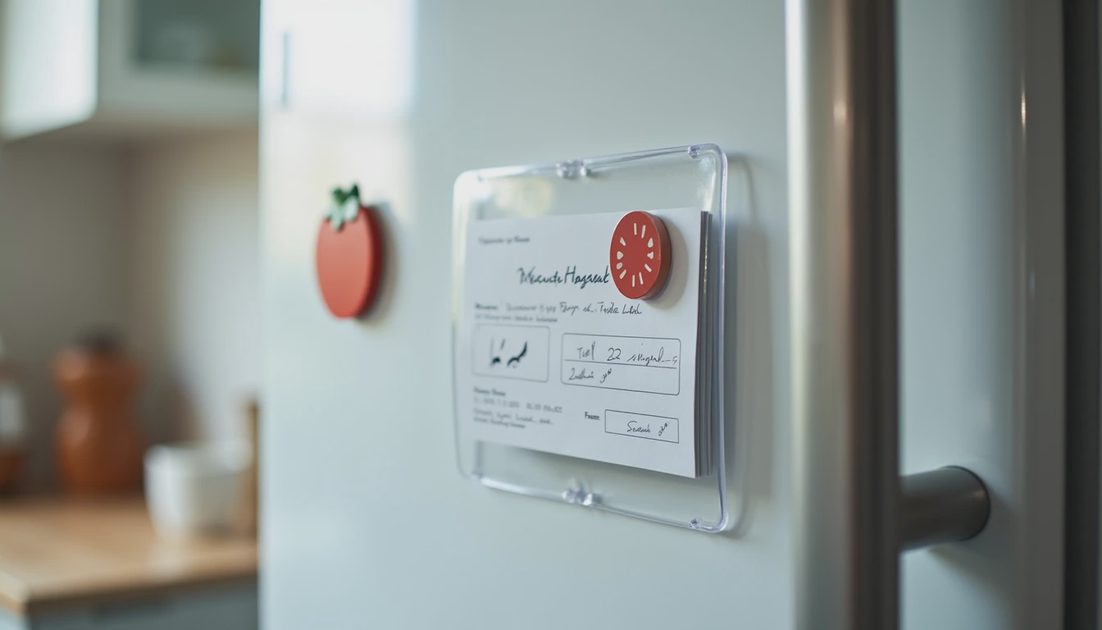
Think in groups, and leave two blank lines under each group so the card can be updated with a pen. Print it in a large, plain font, then ask your parent to read it out loud. If they hesitate on a line, that line is wrong.
Group | Examples of what to write |
|---|---|
People first | Two adult children with cell numbers, one nearby neighbor, one trusted friend |
Health | Primary doctor, one specialist, pharmacy, health insurance member services |
Money | Bank branch phone number, debit card lost-or-stolen line, credit card support |
Home | Electric and gas utility, water, internet provider, landlord if applicable |
Access | The name of the phone carrier, the internet router brand, and the device passcode hint |
Paper trail | Where the car title, insurance policy, and will are kept, and who has copies |
Notice that the passcode line says hint, not code. That distinction matters, and it is the subject of the next section.

What Must Never Be Written on the Card
An emergency card is meant to be read by other people, sometimes by strangers. Treat it as a document that could be photographed in a wallet, handed to a clerk, or left on a counter, and write it accordingly.
No full passwords of any kind, for any account, ever.
No full debit, credit, or bank account numbers — write the last four digits only.
No Social Security numbers, and no Medicare or insurance identification numbers.
No answers to security questions, and no recovery codes.
No full date of birth combined with a mother's maiden name or other identity clues.
No hidden safe combinations or keypad codes.
Instead of the secret itself, write where the secret lives: "Passwords: in the password manager, entry named Bank," or "Passwords: in the sealed envelope in the desk drawer." A password manager is a program that stores many passwords behind one master password, and it is a reasonable choice for a household that is comfortable with it. A sealed written record in a known place is a reasonable choice for a household that is not. The card should point to whichever one your family uses, and nothing more.
Where to Keep Copies
Make three copies and keep them in different places, because the moment you need the card is the moment it will not be where you expect.
One in a kitchen drawer that everyone in the house can find without moving furniture.
One inside the wallet or purse, in a sleeve behind a photo, with passcode hints removed.
One at your own home, two hours away, in the folder where you keep insurance paperwork.
One photograph of the card, saved in your phone, for the times when you are the one making calls.
If your parents have a neighbor who checks in on them, offer a copy. My mother's neighbor Deb has one, and she has used it twice — once for a pharmacy refill question, and once to reach me while my mother was at a clinic appointment. A card that only exists at your house does not help the people standing next to your parent. Much of the technology help for elderly parents that actually gets used is shared this way: plain, printed, and findable at two in the morning.
The Once-a-Year Review Ritual
Cards drift out of date quietly. Banks merge, doctors retire, and internet providers change their support numbers about as often as Minnesotans change their snow tires. This review is the annual version of technology help for elderly parents: a short, scheduled check instead of a panicked search through drawers.
Pick a date that you will not forget — a birthday, the start of a new year, the first Sunday after Thanksgiving — and spend fifteen minutes reading the card out loud together. Replace anything that has changed, write the new date in the corner, and reprint it if the pen marks have piled up. I keep this review on the same handwritten "things Mom may ask about" list beside my laptop, right under the note about her pharmacy's new automated refill line. My husband Evan, who grades a hundred science quizzes a week, points out that anything reviewed once a year gets reviewed zero times a year unless it is on a calendar. He is right.
Between the baking projects and the container tomatoes on the deck, our family has learned that the calmest emergency is the one you prepared for on an ordinary Tuesday. Let's make the next click the easy one.